

Understanding How Eye Movement Desensitization and Reprocessing Can Support Your Healing Journey
EMDR therapy has helped over 7 million people worldwide heal from trauma, anxiety disorders, and other mental health conditions. This evidence-based therapy uses bilateral stimulation—like guided eye movements—to help your brain process traumatic memories and reduce their emotional impact. As someone who has personally survived sexual abuse and eating disorders, I understand the profound transformation that’s possible when you find the right therapeutic approach that truly meets your needs.
What EMDR Therapy Treats:
- Sexual abuse and psychological trauma
- Eating disorders and compulsive behaviors
- Post traumatic stress disorder and complex trauma
- Anxiety disorders and depression rooted in traumatic experiences
- Self-doubt, perfectionism, and negative beliefs
- Spiritual disconnection and emotional trauma
How EMDR Therapy Works: Eight phase treatment approach using bilateral stimulation to process traumatic memories
Timeline: Varies by individual – some see improvement after just a few EMDR therapy sessions
Recognition: Endorsed by World Health Organization and American Psychiatric Association
If you’ve been struggling with distressing memories or feeling stuck despite your achievements, EMDR therapy at True Mind Therapy could be the breakthrough you’re looking for. Unlike traditional talk therapy, Eye Movement Desensitization and Reprocessing (EMDR) doesn’t require you to relive traumatic events in detail—instead, it helps your brain heal naturally by mimicking the memory processing that occurs during REM sleep.
EMDR therapy was founded in 1987 when Dr. Francine Shapiro noticed her own distressing thoughts became less bothersome while her eyes moved back and forth during a walk in the woods. What started as a personal observation has grown into a globally recognized treatment that I’m passionate about offering to women ready to reclaim their power.
I’m here to help you rebuild your sense of safety and trust through trauma-informed care, combining my clinical expertise in EMDR therapy with my lived experience as a survivor who has walked this healing path.
What You’ll Learn in This Guide
This comprehensive guide will walk you through everything you need to know about EMDR therapy and how it can support your healing journey. We’ll explore the eight phase treatment approach, examine the scientific evidence behind its effectiveness, and address the questions I hear most frequently from clients considering this transformative EMDR treatment.
Understanding EMDR Therapy: The Science Behind Your Brain’s Natural Healing
Eye movement desensitization and reprocessing stands for Eye Movement Desensitization and Reprocessing, built on the Adaptive Information Processing Model. Think of your brain like a filing system—when everything’s working smoothly, daily experiences get properly sorted and stored away. But when trauma happens, it’s like the filing system gets jammed.
Traumatic memories can become “frozen in time,” keeping all their original emotional intensity, physical sensations, and negative beliefs intact. Instead of being filed away as something that happened in the past, these traumatic memories stay raw and present, making you feel as if the traumatic events are happening right now. This is especially true for experiences of sexual abuse or other traumatic experiences that create deep wounds in your sense of self and safety.
Here’s where EMDR therapy becomes fascinating: it appears to restart your brain’s natural healing process. During EMDR therapy sessions, bilateral stimulation—usually guided eye movements—activates the same neural pathways that work during REM sleep when your brain naturally processes disturbing memories.
The science suggests EMDR works through several pathways. When you’re paying attention to both a disturbing event and the bilateral stimulation, the traumatic image loses some of its intensity. Studies have also found measurable physiological changes during bilateral stimulation—heart rates slow down, stress responses calm, and your nervous system shifts into a more relaxed state, helping to process traumatic memories more effectively.
A Brief History: From Personal Discovery to Global Recognition
The story of EMDR therapy begins with a simple walk in the woods. In 1987, Dr. Shapiro noticed something remarkable during her stroll—her own distressing thoughts seemed to lose their grip when her eyes naturally moved back and forth while she walked. What started as a personal observation would eventually help millions of people worldwide through eye movement desensitization and reprocessing.
Dr. Shapiro’s finding led to the first clinical trial published in 1989, and the results were so promising that EMDR therapy began spreading rapidly through the mental health community. The EMDR International Association was formed to support training and research, and today, more than 110,000 EMDR therapists across 130 countries use this approach. Research continues to support its effectiveness for treating trauma and other mental health issues.
How EMDR Therapy Supports Your Healing Journey
EMDR therapy has become a cornerstone in treating posttraumatic stress disorder and other mental health conditions, offering hope and healing for women struggling with complex trauma, sexual abuse, and compulsive behaviors. What sets eye movement desensitization and reprocessing apart is its ability to help you process traumatic memories that often lie at the heart of persistent mental health issues.
Instead of simply managing symptoms, EMDR therapy targets the root cause—those unresolved traumatic experiences that continue to trigger negative emotions and keep you feeling stuck. Through the process of desensitization and reprocessing EMDR, you can reduce the emotional intensity of traumatic memories, allowing for genuine healing and the reclamation of your inner power.
This approach addresses the underlying traumatic stress and helps your brain reprocess difficult memories, empowering you to move beyond the grip of the past. Whether you’re dealing with childhood sexual abuse, complex trauma, or eating disorders that developed as coping mechanisms, EMDR therapy offers a path to lasting relief and spiritual reconnection.
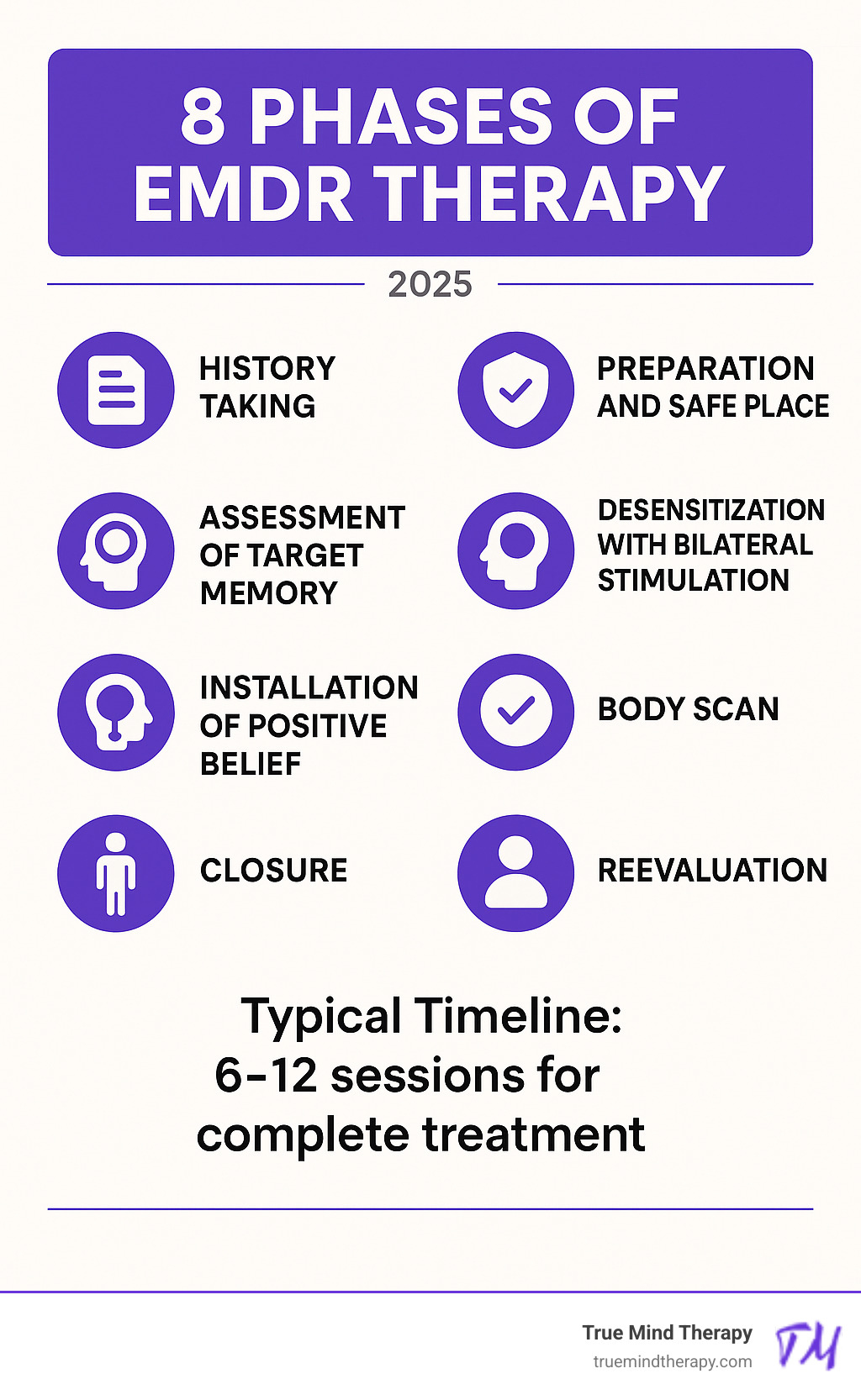
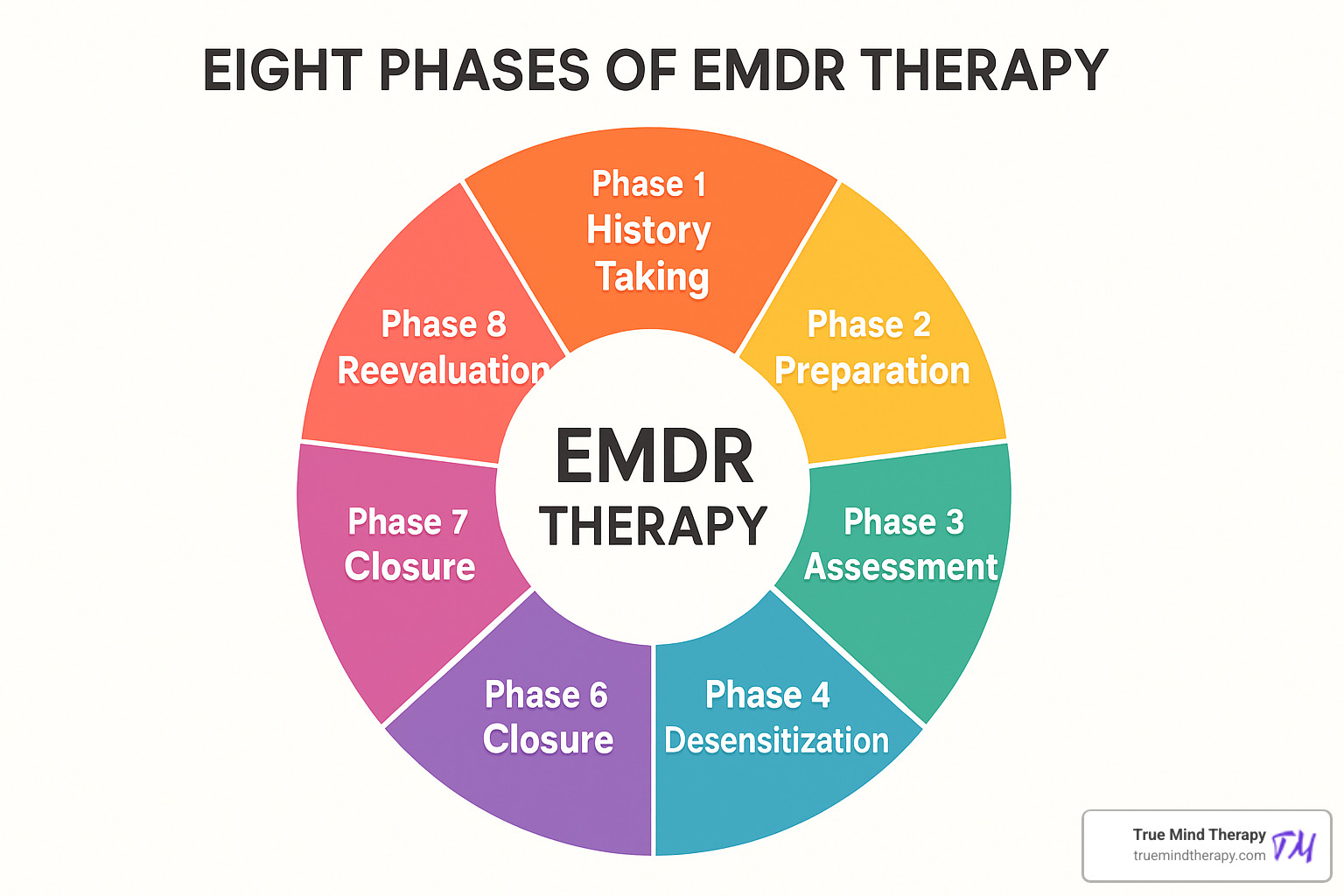
The Eight Phase Treatment Approach: Your Step-by-Step Healing Journey
Think of EMDR treatment like building a house—you need a solid foundation before you can construct the rest. The eight phase protocol ensures we create that foundation together, then carefully work through processing traumatic memories in a way that feels safe and manageable.
The beauty of this structured EMDR protocol is that it takes the guesswork out of trauma therapy. We’re not just talking about your problems—we’re systematically addressing them using a method that’s helped millions of women worldwide reclaim their lives through successful treatment.
Phases 1–2: Laying the Groundwork
Phase 1 is all about getting to know you and your story. During my history-taking sessions, I’ll explore what brought you to EMDR therapy and identify which traumatic experiences might be good targets for EMDR processing. We’ll create a treatment plan that maps out your goals and identifies the traumatic memories that seem to be driving your current symptoms.
Phase 2 is where we build your toolkit. Before we start processing any disturbing memories, I want to make sure you have solid coping skills and relaxation techniques you can use during and between EMDR therapy sessions. We’ll practice grounding exercises and establish what we call a “Safe/Calm Place”—a mental refuge you can access whenever you need to feel more centered.
Phases 3–6: Processing & Reprocessing
Phase 3 involves target assessment—we’ll identify the specific traumatic memory we want to work on and measure how disturbing it feels right now using the SUD scale (Subjective Units of Disturbance), where 0 means no distress and 10 means the worst possible distress. We’ll also identify the negative beliefs you hold about yourself related to this memory and figure out what positive belief you’d rather have.
Phase 4 is desensitization—this is where the bilateral stimulation begins. While you hold the targeted memory in mind, I’ll guide you through bilateral sets of eye movements, usually lasting about 30 seconds each. After each set, you’ll share whatever comes up—thoughts, feelings, images, or body sensations. The goal is helping that traumatic memory feel less emotionally charged through this EMDR processing.
Phase 5 focuses on installation of positive beliefs. Once the memory’s emotional charge has decreased significantly, we use bilateral stimulation to strengthen that positive belief about yourself. In Phase 6, we do a body scan to check for any remaining physical sensations or discomfort related to the memory.
Phases 7–8: Closure & Reevaluation
Every EMDR session ends with Phase 7 closure techniques. I use specific strategies to help you feel grounded and stable before you leave. EMDR therapy typically requires no homework—your brain continues processing traumatic memories between sessions naturally.
Phase 8 happens at the beginning of my next EMDR therapy session with you. We’ll check on the memory we processed to make sure the positive changes have held steady and identify my next targets for EMDR processing with you.
EMDR Intensives: Accelerated Healing for Busy Professional Women
For women who want to make significant progress quickly, I offer EMDR intensives. These extended EMDR therapy sessions allow us to work through multiple phases of the eight phase treatment approach in concentrated blocks of time, often leading to faster breakthroughs than traditional weekly appointments.
EMDR intensives are particularly beneficial for professional women who have demanding schedules and want to address their trauma without the stop-and-start nature of weekly EMDR therapy sessions. Intensive sessions can range from half-day to multi-day formats, allowing you to maintain momentum in your healing journey through focused EMDR treatment.
Who Benefits Most from EMDR Therapy
The women who tend to thrive with EMDR therapy are those who:
- Have some basic coping skills in place
- Maintain a reasonably stable living situation
- Feel ready to experience uncomfortable emotions temporarily in service of healing
- Have some kind of support system, even if it’s small
- Are spiritually oriented and seeking deeper connection to themselves
- Want to address the root causes blocking their joy and manifestation abilities
At True Mind Therapy, I work specifically with professional women who are successful in many areas of life but find that unresolved trauma is preventing them from experiencing true joy, deeper relationships, and their full potential. You may have been avoiding or trying to bury your traumatic experiences for years, but you’ve reached a point where those strategies aren’t working anymore.
My Unique EMDR Practice: Clinical Expertise Combined with Lived Experience
What sets my EMDR practice apart is my combination of clinical training with personal experience as a survivor of sexual abuse and eating disorders. This allows my clients to connect more deeply, feel genuinely safe, and dig into their trauma with an EMDR therapist who truly understands their journey.
I’ve been on this path of healing myself, and I’m passionate about leading women into their power using EMDR therapy, EMDR intensives, and adjunct therapeutic approaches. My lived experience, combined with my clinical skills and spiritual approach, creates a unique therapeutic container for deep healing work through eye movement desensitization and reprocessing.
What to Expect: Your Journey with Me
Intake Process
My intake process is straightforward and respectful of your time. I’ll send you paperwork that takes about 10 minutes to complete, and then we’ll schedule your first appointment for assessment. This allows us to get right to the heart of what brought you to EMDR therapy.
Ongoing Support
Once we begin working together, I’m available by phone or email between 10am and 7pm if you have questions or concerns about your EMDR treatment. I always respond within 24 hours, but usually within the same day. This accessibility between EMDR therapy sessions is part of your treatment—I understand that healing doesn’t stop when you leave my office.
Treatment Approach
My approach integrates EMDR therapy with spiritual awareness and adjunct therapeutic techniques tailored to your specific mental health conditions. We’ll work together to address sexual abuse trauma, eating disorders, and other trauma responses that have kept you from experiencing your full power and joy through effective treatment.
The Effectiveness of EMDR Therapy: What Research Shows
When women ask me about how EMDR works and its effectiveness, I’m excited to share the robust research behind this approach. More than 30 controlled studies have demonstrated that EMDR therapy works as well as cognitive behavioural therapy and other evidence-based treatments for treating trauma and other mental health conditions.
The numbers tell a compelling story about this effective treatment:
- Over 7 million people have received EMDR treatment worldwide
- Many people start noticing real improvement after only a few EMDR therapy sessions
- The benefits of successful treatment often last long after EMDR therapy ends
- Processing of a specific traumatic memory typically completes within one to three sessions
Studies show that 77% of people with posttraumatic stress disorder experience significant improvement with EMDR therapy, while 100% of single-trauma survivors and 77% of those with multiple traumas no longer meet criteria for post traumatic stress disorder after completing treatment. This makes EMDR therapy highly effective as a PTSD treatment and for treating posttraumatic stress disorder symptoms.
Research from the World Health Organization and American Psychiatric Association confirms EMDR therapy as an effective treatment for post traumatic stress and other mental health issues.
Benefits and Considerations of EMDR Therapy
The advantages of EMDR therapy often surprise women who come to see me:
- No homework or between-session assignments required
- You don’t need to describe traumatic events in detail
- Often works faster than other treatments like traditional talk therapy
- Can address multiple traumatic memories efficiently through EMDR processing
- Helps reconnect you with your spiritual self and inner power
- Reduces negative emotions and strengthens positive beliefs
Like any effective treatment, EMDR therapy does involve some temporary challenges. You might experience a brief increase in distressing emotions or dreams as your brain processes difficult material. The approach requires willingness to experience some discomfort during EMDR processing sessions, though this typically decreases as traumatic memories become less emotionally charged.
Sessions Needed and Timeline for EMDR Treatment
The timeline for EMDR therapy varies based on your unique situation:
- Single-incident trauma often resolves in 3-6 EMDR therapy sessions
- Complex trauma or childhood trauma typically requires 8-12 sessions or more
- Multiple traumatic experiences usually need 1-3 sessions per targeted memory
For women seeking more concentrated healing, my EMDR intensives offer formats ranging from half-day to multi-day sessions, allowing for deeper work and faster progress through the eight phase treatment approach.
What’s especially encouraging about EMDR therapy research is that the benefits tend to be lasting. Unlike other treatments that require ongoing maintenance, most women find that once traumatic memories are processed through eye movement desensitization and reprocessing, they stay processed.
Preparing for Your EMDR Therapy Journey
Taking the first step toward EMDR treatment can feel overwhelming, but beginning your healing journey doesn’t have to be complicated. The most important thing is working with an EMDR therapist who has proper training and makes you feel safe and understood.
I have specialized training through the EMDR International Association and understand how important it is to create a space where healing can happen naturally. As someone who has walked this path personally, I bring both clinical expertise and genuine understanding to your EMDR therapy process.
Assessing Your Readiness for EMDR Therapy
Before beginning EMDR treatment, it helps to honestly assess your readiness:
- Emotional readiness: Being willing to feel some uncomfortable emotions in service of long-term healing
- Practical readiness: Having your basic needs met—stable housing, reliable transportation, and a plan for treatment
- Spiritual openness: Being ready to reconnect with your inner power and authentic self
Online and In-Person EMDR Therapy Options
I offer both in-person EMDR therapy sessions in Austin and online therapy options. Telehealth EMDR therapy can be just as effective as in-person sessions, giving you flexibility in how you access treatment. Whether you choose traditional weekly sessions, online EMDR therapy, or an intensive format, the most important factor is feeling genuinely seen and supported in your healing journey.
Frequently Asked Questions About EMDR Therapy
Is EMDR therapy only for trauma?
While eye movement desensitization and reprocessing was originally developed for treating posttraumatic stress disorder, it’s actually much more versatile. EMDR therapy works well for other mental health conditions because many of your current struggles have roots in past traumatic experiences that haven’t been fully processed.
EMDR therapy can effectively treat:
- Anxiety disorders that seem to come from nowhere
- Depression that feels stuck despite other treatments
- Self-doubt, perfectionism, and negative beliefs
- Spiritual disconnection and emotional trauma
- Eating disorders and compulsive behaviors
- Negative emotions that you can’t seem to shake
Sometimes women come to me feeling like their experiences “weren’t traumatic enough” to warrant EMDR therapy. But those painful moments from childhood, difficult experiences, or ongoing patterns that keep you stuck can absolutely benefit from this approach. If it’s still bothering you and blocking your joy, it’s worth addressing through EMDR treatment.
How many EMDR therapy sessions will I need?
This varies from person to person, like asking how long it takes to heal from a physical injury—it depends on what happened, how long ago, and how your brain responds to EMDR treatment.
For single-incident traumas, most women see significant improvement within 3-6 EMDR therapy sessions. Complex trauma or multiple incidents typically require more time, often 8-12 sessions or more of EMDR processing.
Here’s what I find encouraging: each individual traumatic memory usually only needs 1-3 EMDR therapy sessions to fully process. So even if you have multiple traumatic memories, we’re not talking about years and years of treatment. Your brain wants to heal—I’m just providing the right conditions for that to happen through eye movement desensitization and reprocessing.
What if I feel worse after an EMDR session?
Feeling stirred up after EMDR therapy sessions is completely normal, especially in the early stages. It doesn’t mean EMDR therapy isn’t working—it often means your brain is actively doing the healing work of processing traumatic memories.
You might experience:
- Vivid dreams or changes in sleep patterns
- Temporary increases in negative emotions you’ve been processing
- Physical sensations like fatigue or tension
- New memories or insights emerging
Every EMDR session ends with grounding techniques to help you feel stable before you leave, and you’ll have all those coping strategies we practiced during preparation. Most women find these stirred-up feelings settle within 24-48 hours as the EMDR processing continues naturally.
If you’re ever concerned about how you’re feeling between EMDR therapy sessions, please reach out. I can always adjust the pace of treatment or spend more time on stabilization. There’s no rush—healing through EMDR therapy happens at your own speed.

Your Path to Reclaiming Your Power Through EMDR Therapy
Your healing journey doesn’t have to be a long, winding road filled with years of traditional talk therapy. EMDR therapy offers something different—a research-backed approach that works with your brain’s natural ability to heal and process traumatic experiences.
What makes EMDR therapy so powerful is its simplicity. You don’t need to spend months building up to discussing your trauma. You don’t need homework assignments or lengthy verbal processing. Instead, eye movement desensitization and reprocessing helps your brain do what it already knows how to do—integrate traumatic memories so they stop causing daily distress.
At True Mind Therapy, I’ve witnessed countless women transform their relationship with their past and reclaim their inner power through EMDR therapy. The professional who couldn’t sleep without nightmares. The survivor who finally felt safe in her own body. The successful woman who discovered she could have both achievement and joy through effective treatment.
Your path forward might include:
- Traditional weekly EMDR therapy sessions for steady, consistent progress
- EMDR intensives for rapid transformation through concentrated treatment
- A combination approach that fits your unique schedule and spiritual journey
The beauty of EMDR therapy is that it meets you where you are. Whether you’re dealing with sexual abuse trauma, complex childhood experiences, or eating disorders that developed as survival mechanisms, there’s a way to make this effective treatment work for you.
I understand that taking the first step toward EMDR treatment can feel scary. Here’s the truth: if traumatic memories are impacting your daily life and blocking you from your full potential, you deserve support. And you’re absolutely strong enough—you’ve survived everything that brought you to this point.
Ready to Begin Your Transformation Through EMDR Therapy?
The journey from surviving to thriving is possible—and with True Mind Therapy, you don’t have to do it alone. EMDR therapy isn’t a quick fix, but it’s a proven approach that helps women regain control and move beyond the weight of unresolved trauma. Your brain is built to heal; sometimes it just needs the expert support and guidance that True Mind Therapy provides through eye movement desensitization and reprocessing.
As someone who has walked this path personally and professionally, I’m here to guide you through this transformative EMDR therapy process. My combination of clinical expertise, spiritual awareness, and lived experience creates a unique container for the deep healing work that leads to lasting change through effective treatment.
If you’re ready to explore whether EMDR therapy is right for you, I invite you to reach out. We can discuss your specific situation and determine the best approach for your healing journey through EMDR treatment. Remember, seeking help isn’t a sign of weakness—it’s a sign that you’re ready to invest in your own wellbeing and step into your full power.
Your transformation through EMDR therapy is possible. Your joy is waiting. And you deserve to experience the fullness of life that trauma has kept from you. Let’s begin this healing journey together.